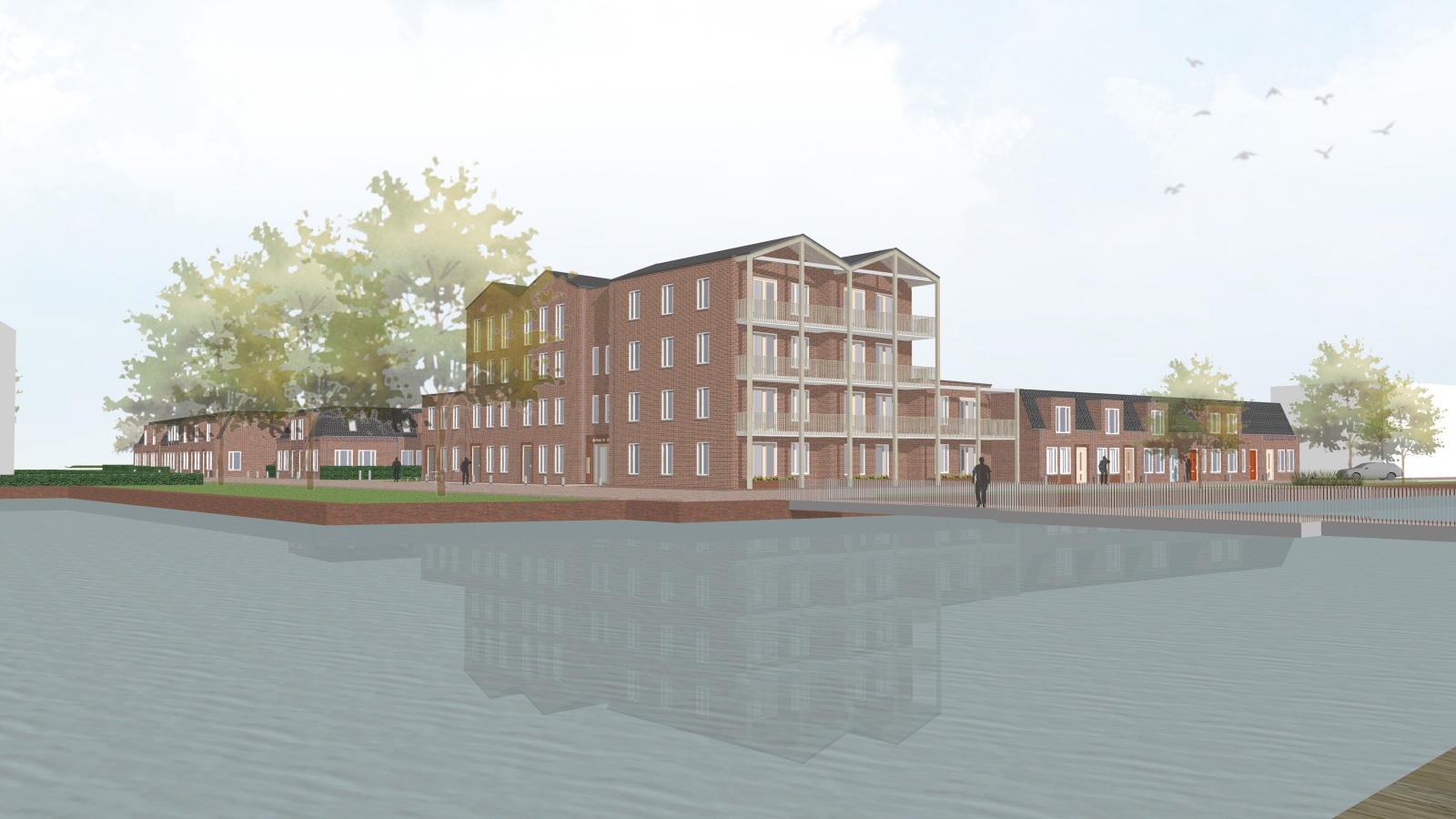
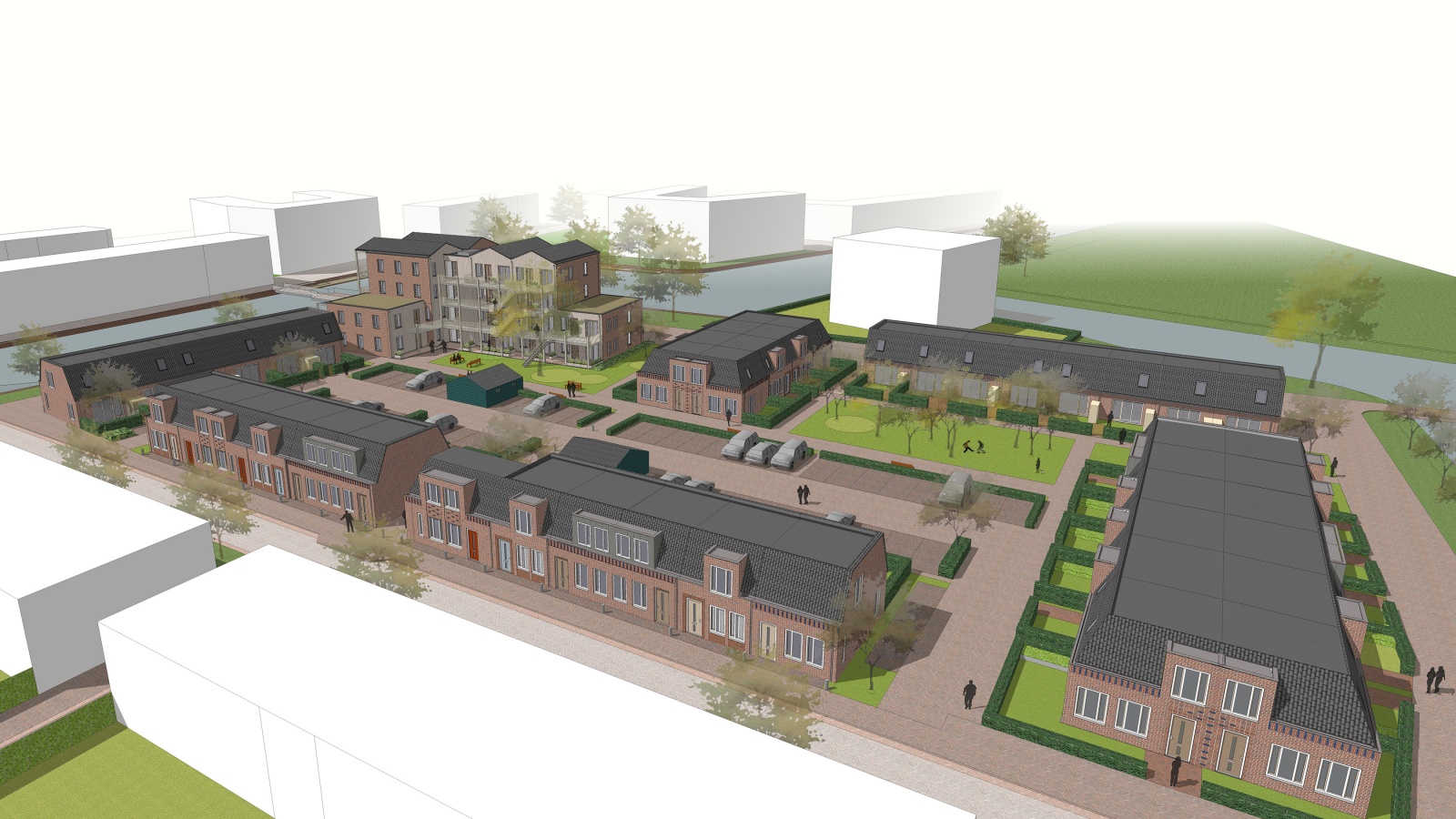
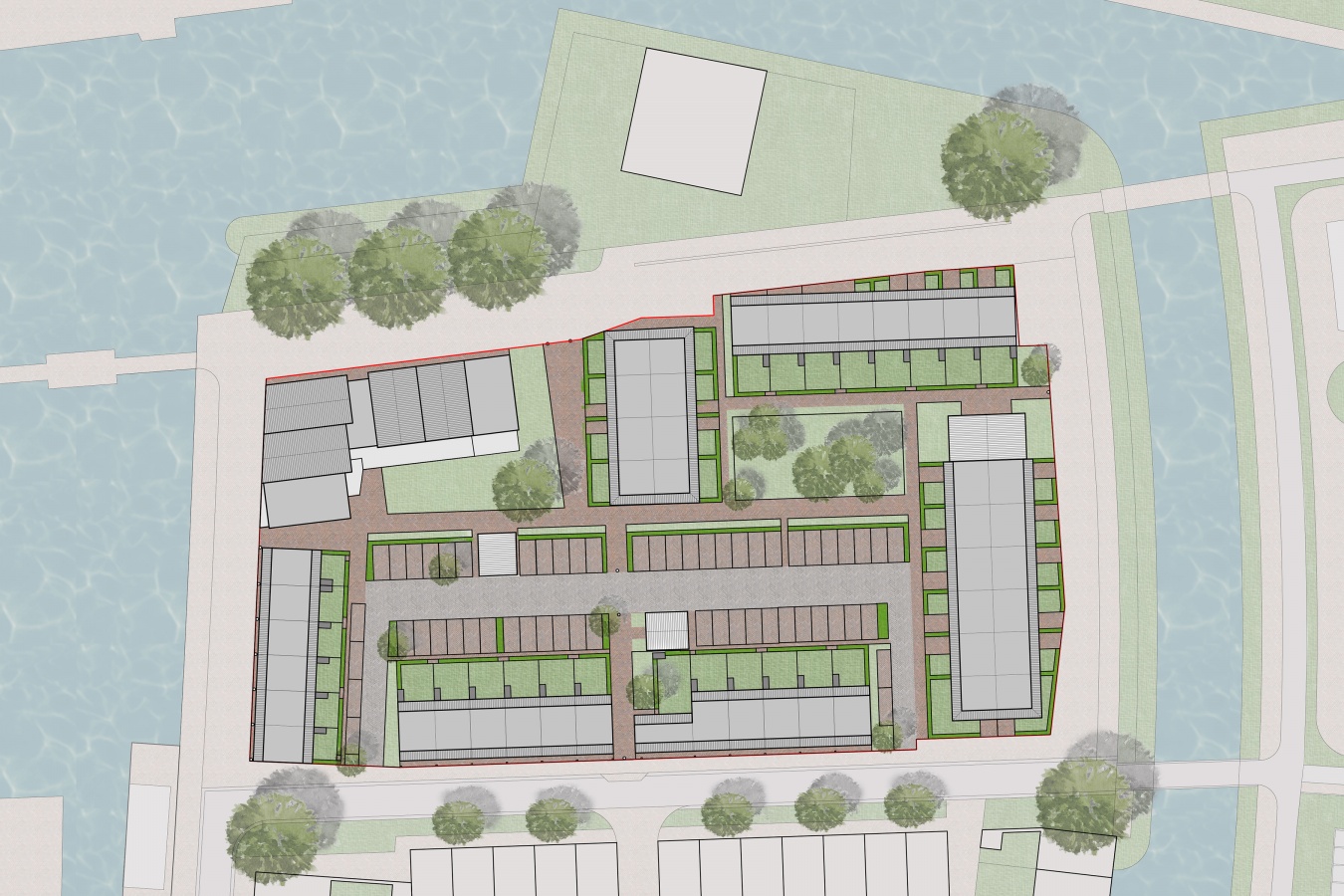
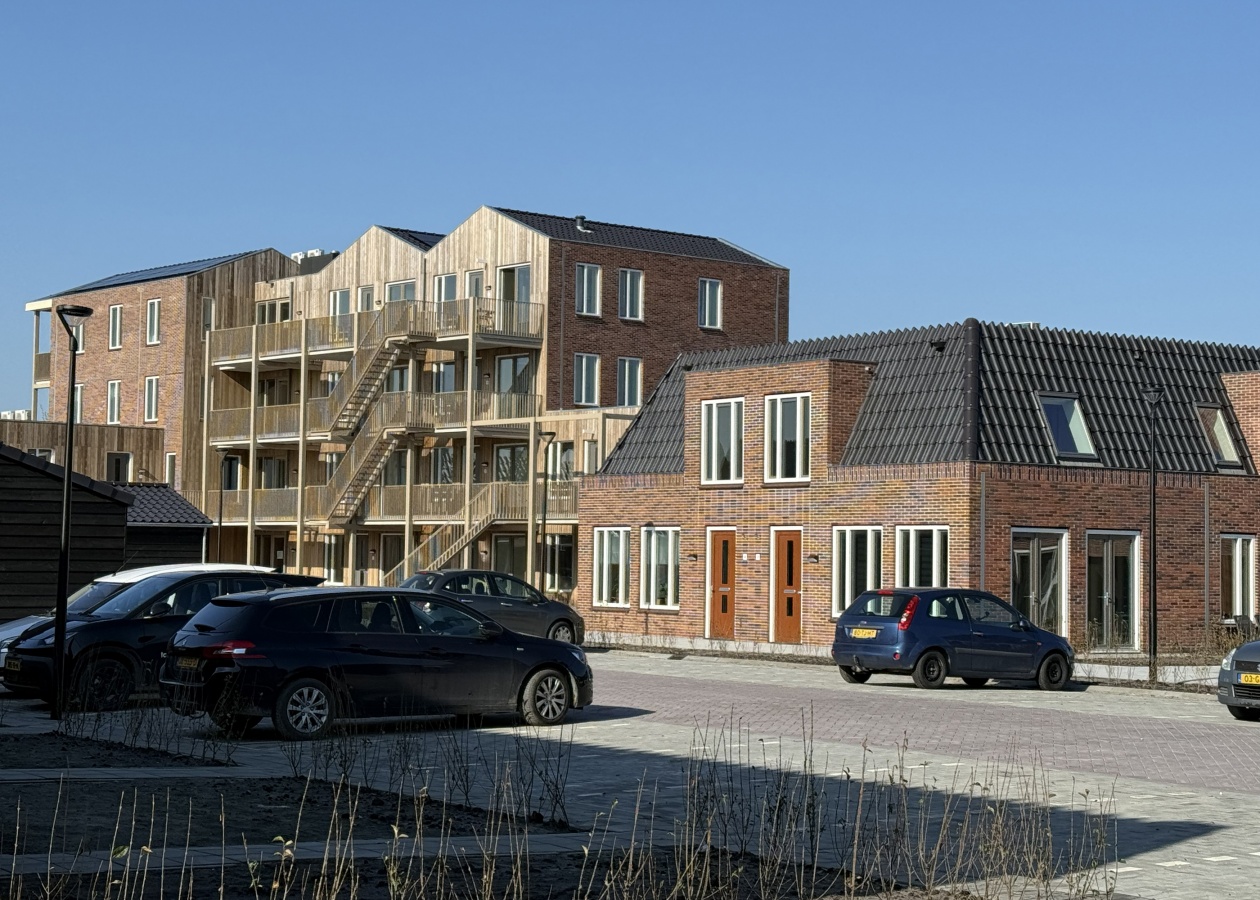
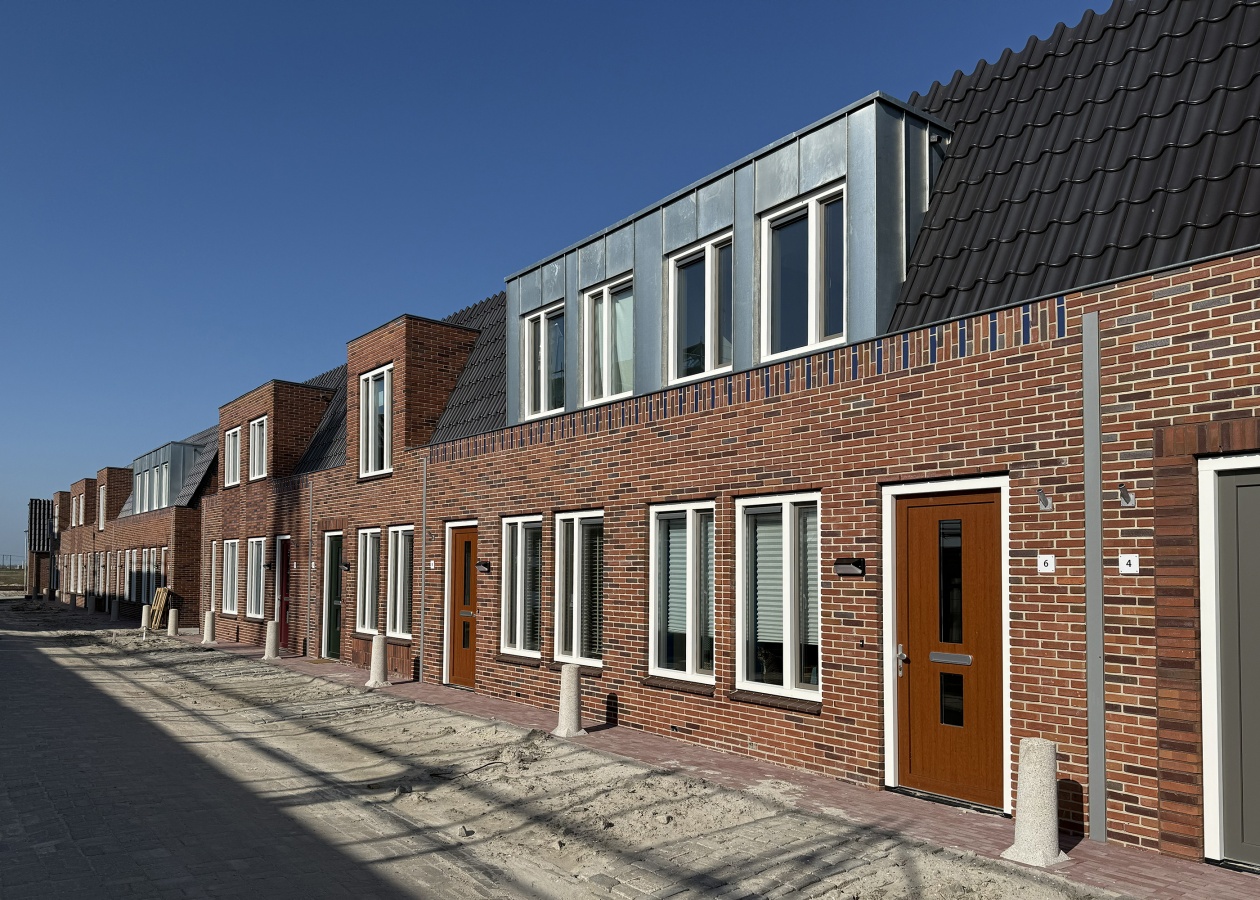
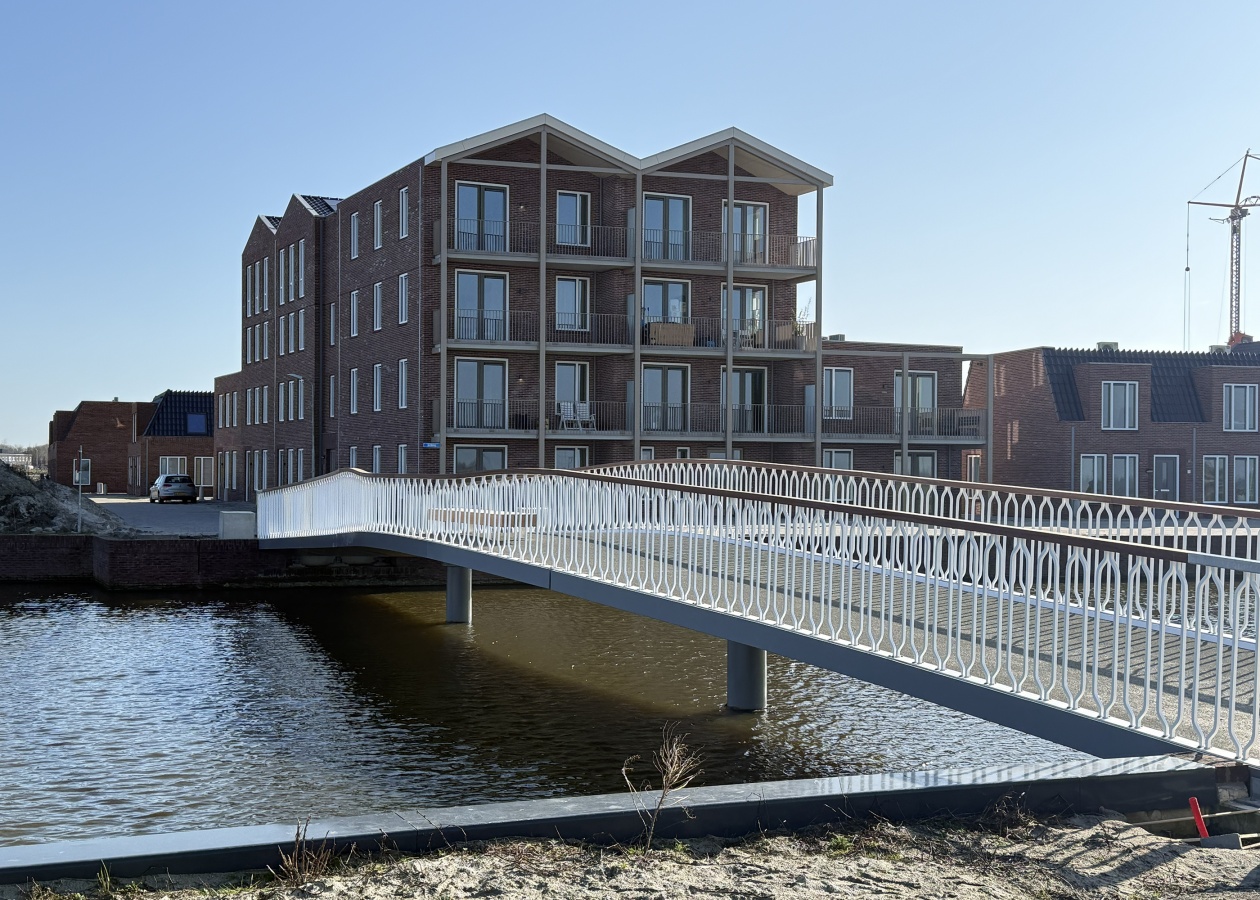
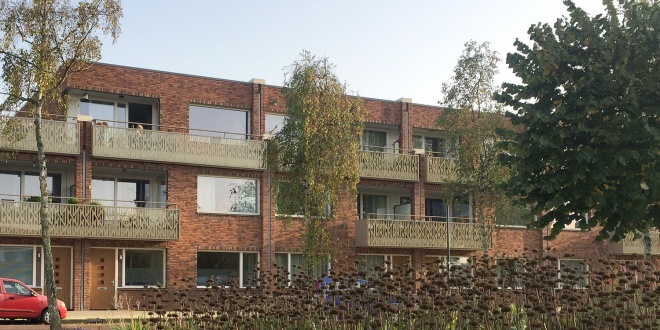
Middelsee is the expansion plan on the southwest side of Leeuwarden, based on an urban design by West 8. The Frisian water city serves as a source of inspiration. Commissioned by the smallest housing association in the Netherlands, we have designed a plan for homes arranged around two green courtyards. It forms a small-scale community with plenty of space for encounters, and a robust waterfront with the apartment building as its eye-catcher.
Using simple means, variety is created so that no more than two houses are ever the same. The foundation remains consistent: a compact floor plan, lightly jointed red brickwork, and solid white window frames. We introduce variation through a dormer or a brick roof extension, a roof edge detail, or a distinctive entrance feature. The client’s existing housing stock in Leeuwarden’s city center also served as inspiration — a characteristic working-class neighborhood with abundant greenery.
In our plan, residents meet each other around private stoops and gardens bordered by low hedges, as well as along the wide galleries on the timber façade of the apartment building. Shared bicycle storage areas and shared cars also contribute to the sense of community.
| Architects | Krijn Tabbers, Ronald Knappers |
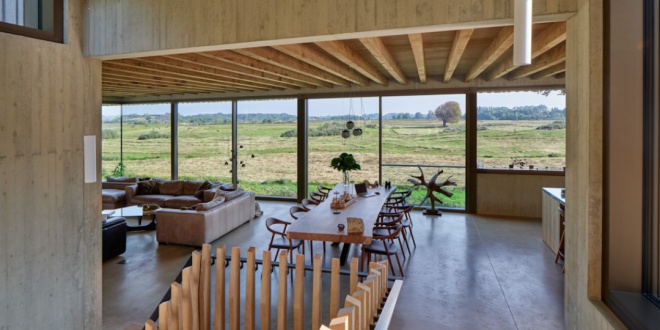
The “Villa van Bergenlaan” is located in Rijksdorp, Wassenaar, on the edge of a Natura 2000 protected area.
Situated along a dune ridge, it overlooks the Lentevreugd nature reserve. The villa is modest in expression, partially embedded into the dune, allowing it to become an integral part of the landscape. Energy for the house is generated from sun and air. Because the villa is partly underground, a hybrid structure of concrete and timber has been created.
The materials — including native oak, Fraké wood, concrete, and anodized aluminium — reveal their natural character; nothing is concealed, and in some cases the materials are given a special treatment, such as the wooden slat pattern cast into the concrete. The external façade, one to two storeys high, is clad in timber with concealed window frames.
Characteristic of the villa is the experience of light, space, materiality, and connection with the surrounding landscape. The villa is composed as a sequence of distinct spatial volumes — a modern interpretation of the “Raumplan” principle.
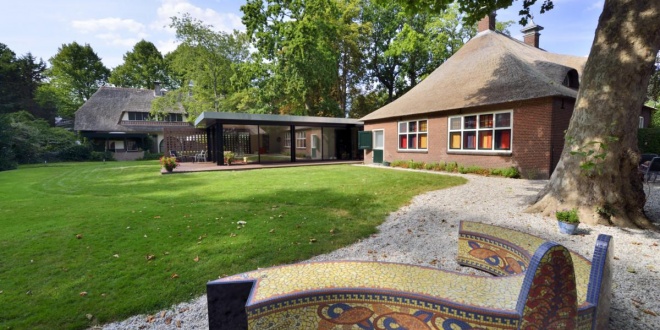
The house from the beginning of the 20th century was originally the staff residence of the adjacent main house “Malgre tout”. The main house and staff house are seen as examples of the development of country estates in the municipality. As an ensemble, the buildings and the surrounding gardens are of great cultural-historical value. The ensemble has the status of a national monument. The carefully detailed house is built in red brick under a thatched wolf roof. The staff house originally included a garage, horsestables and a driver's house.
In 2018, a design was made for the restoration and modernization of the service residence including a modern extension. A large living room and kitchen will be realized in the extension. A veranda will be added to the extension. Living room and veranda offer a view of a beautiful Hortensia garden. The extension is completely transparent on the side of the garden. On the other side, the extension is embraced by an openwork masonry wall. The wall becomes more transparent towards the edges. By using a heat pump installation with a source, high-quality insulation, and by completely filling the roof of the extension with solar panels, the service house will soon be completely energy neutral.
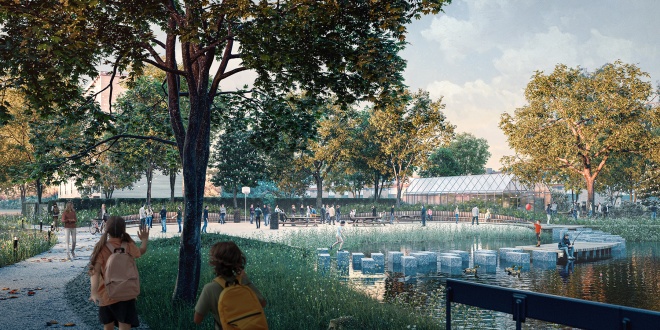
In the summer of 2024, the municipality of Leiden launched an ideas competition for the Second Green Ring. Following the success of the Singelpark around the historic city center, the idea emerged to connect the parks and waterways along the city’s edge into one continuous whole — a green-blue ring where residents of the densely built city can recreate, exercise, experience nature, and meet one another.
Studio VVKH, together with partners in the fields of landscape architecture, water management, ecology, and industrial design, submitted a vision titled ‘Het Leidse Lint’ (“The Leiden Ribbon”). With this vision, we were among the three finalists invited to present their plans to a broad jury in March of this year. The citizens of Leiden were also able to view the proposals and share their opinions.
Our submission achieved second place. The winning proposal was ‘Panoramapark’ by Polyfern. We are proud of this result and greatly enjoyed developing our ideas for the city. The importance of outdoor space — for people, plants, and animals alike — will increasingly come to the forefront of design at all scales in the years ahead.
You can download the presentation boards of ‘Het Leidse Lint’ here.
The design team consisted of:
VVKH, Jan Maurits van Linge (landscape office Xi-ontwerp), Simon Akaya (npk design), Yasmin Stip (Stip werkt), Harma van der Meer (TU Delft), and *Ada Jaśkowiec.